The First Time I Realized the Mouth Was the Landscape
I did not start with Taotie’s face. I started with the mouth.
Not teeth—space. An opening that felt architectural rather than anatomical. When I imagined this image as a Halloween backdrop, the question wasn’t how frightening can it be, but how much can it consume without moving.
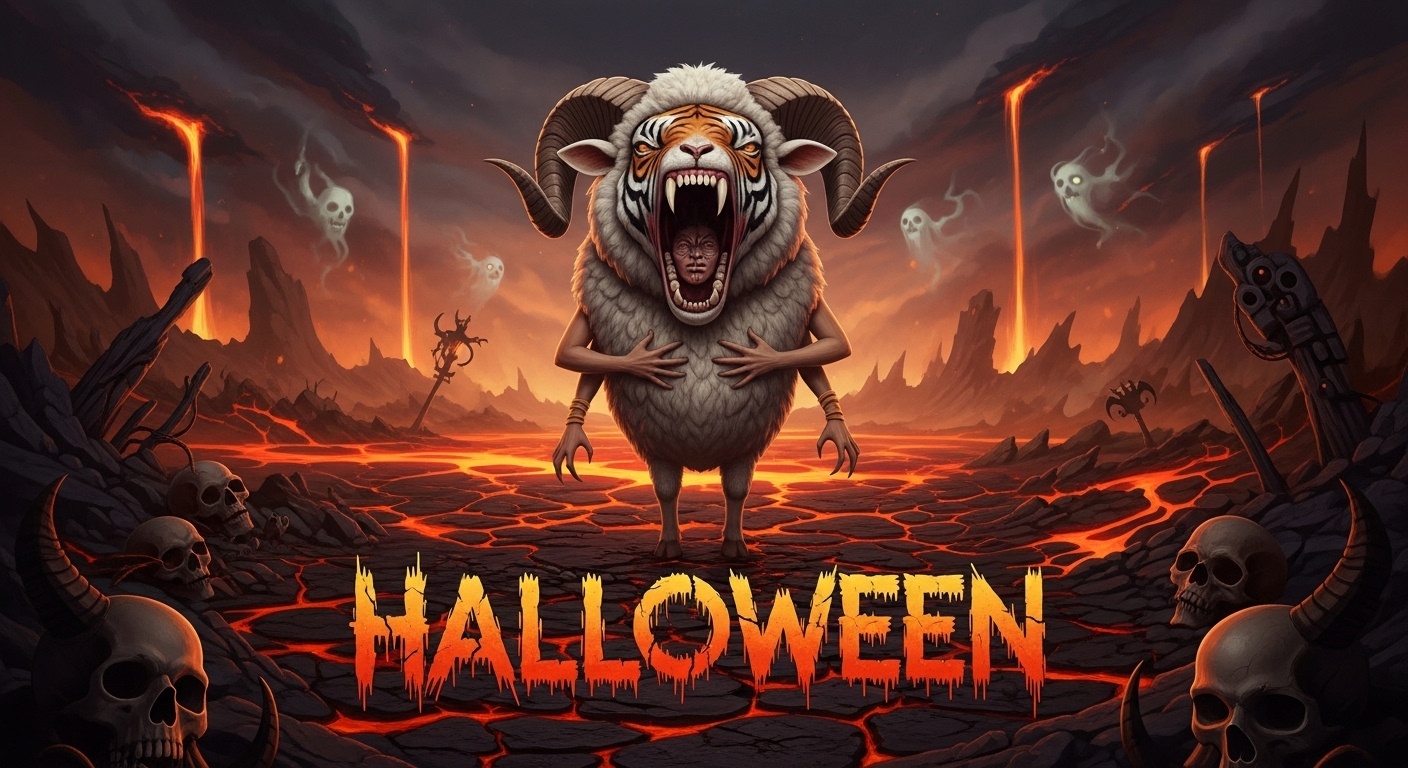
Taotie, in my version, does not chase. It waits. The body—part sheep, part human—feels almost secondary to the appetite. The head is oversized, grotesquely practical. The mouth is wide enough to read as terrain. When people search for how to create a horror backdrop that feels overwhelming rather than aggressive, this distinction matters.
I placed the eyes beneath the arms deliberately. Viewers don’t notice them immediately. They feel watched only after they’ve already been looking too long. This is important in Halloween installations or banners meant to sit behind people in photographs. The fear arrives late.
The surrounding hellscape—lava plains, skeletal debris, demonic silhouettes—is not decoration. It is evidence. This place exists because something here keeps feeding.
As an artist, I hesitated. Would Western audiences understand a monster defined by consumption rather than violence? Then I remembered how familiar endless appetite already feels.
That was the moment Taotie became inevitable.
How I Build a Devouring Horror Backdrop Without Visual Noise
People often ask how to design a large-scale Halloween horror background that doesn’t collapse into clutter. Taotie forces restraint, because excess is already the subject.
1. Establish the mouth as structure.
The mouth must read before the body. I treat it like an archway. Teeth function as columns. Darkness inside is uninterrupted—no glow, no fire. Viewers should feel that nothing returns from it.
2. Delay the eyes.
Placing the eyes beneath the arms breaks expectation. For horror backdrops, delayed recognition creates longer engagement. People lean in. That’s when unease starts working.
3. Body as burden, not power.
The sheep-like torso feels heavy, almost exhausted. Taotie eats not because it is strong, but because it cannot stop. This helps creators searching for how to avoid cartoonish monsters in Halloween scenes.
4. Hell as wide context, not focal point.
The infernal environment must be panoramic. Lava flows horizontally. Demons appear small. Taotie does not rule hell—it outlasts it.
5. Typography as erosion.
The word “Halloween” is not centered. It appears partially consumed, letters bitten away, edges uneven. Designing horror typography this way avoids novelty and reinforces theme.
I don’t decorate greed. I document it.
Why the Image Became Larger Than the Creature
At some point, Taotie stopped feeling like a character.
The background expanded. The hellscape widened. The creature remained still. That imbalance felt right. When viewers ask how to make a horror backdrop feel immersive rather than illustrative, scale is the answer.
Taotie does not dominate by size alone. It dominates by implication. Everything visible feels temporary. Everything unseen feels permanent.
Greed, Ritual, and the Fear of Never Being Finished
Taotie entered my work through observation, not mythology.
I watched how modern spaces encourage consumption without satisfaction. Feeds that never end. Desires that reset immediately after fulfillment. Taotie became a form for that pattern.
In folklore, Taotie eats people. In this reinterpretation, it eats meaning first. The hell imagery—Luciferian silhouettes, demons, skulls—is familiar to Western viewers. Taotie isn’t.
That unfamiliarity is the tension. It forces comparison. Which hunger is more frightening: the one that tempts, or the one that simply exists?
This question guided every compositional choice.
Standing at the Edge of What Cannot Be Filled
I am standing far away, yet the mouth feels close.
The ground trembles, not from movement, but from weight. Lava moves like a slow thought. Demons keep distance. Even they understand boundaries.
I realize the eyes have been watching the entire time.
Not me. The space behind me.
I do not step closer. I do not step back. The mouth does not react. It does not need to.
That is when I understand: this place isn’t punishment. It is digestion.
The Version Where Taotie Was Never Defeated
In this version, Taotie was never chained, never sealed, never warned against.
People simply stopped naming it.
As long as hunger could be blamed on need, Taotie stayed invisible. Only when consumption became identity did it surface again—large, patient, unfinished.
On Halloween, when excess is celebrated briefly, Taotie opens one eye.
Not to judge. To recognize itself.
What Viewers and Creators Commonly Ask About Taotie Horror Backdrops
Q: Is Taotie meant to represent evil?
A: It represents appetite without limit, which predates moral framing.
Q: Why use a sheep-like body instead of a predator?
A: It disrupts expectation and avoids glorifying violence.
Q: Can this work as a wide Halloween banner?
A: Yes. The composition is designed for panoramic formats.
Q: How do you keep the scene readable at a distance?
A: By simplifying movement and emphasizing negative space.
Q: Is the hell imagery symbolic or literal?
A: It is contextual, not narrative.
Q: Why is the mouth so dominant?
A: Because consumption defines the space, not the figure.

Originally reprinted from: free paper - https://frpaper.top/archives/4916