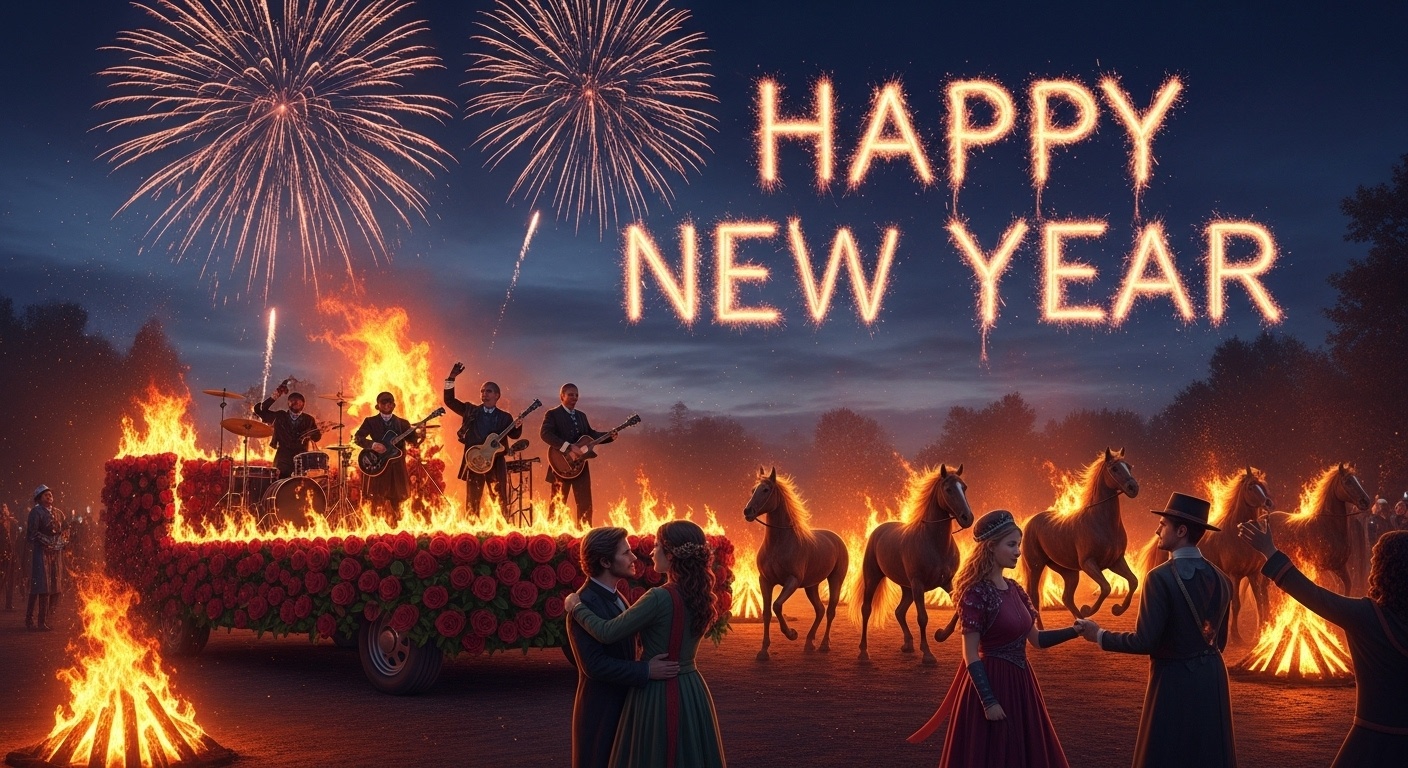
I didn’t imagine this banner as an illustration first — I imagined it as a place I could step into. A wide open celebration space, just before midnight, where firelight replaces streetlights and music replaces silence.
I stand among men and women dressed for winter night air, faces glowing from nearby bonfires. Ahead of us, a massive rose-covered float moves slowly forward. The roses are deep red and warm ivory, layered so densely that they feel ceremonial rather than decorative. On top of the float, a live band performs, their instruments catching sparks and reflections from the surrounding fire.
Above everything, the sky begins to change. Fireworks rise in deliberate arcs, not chaotic bursts. Slowly, purposefully, they begin shaping letters. The words “Happy New Year” appear, formed from streaks of fire, cascading sparks, and glowing ember trails. The typography feels handwritten by motion itself — uneven, alive, and fleeting. Each letter thickens where sparks overlap and thins where smoke drifts away, giving the message a sense of breath and rhythm.
Near the edges of the scene, fire horses move through the celebration. Their forms are elegant rather than aggressive, built from glowing muscle lines and ember-lit manes. Every step they take leaves a short-lived trace of light on the ground, reinforcing the feeling that this night is moving forward whether we follow or not.
Around me, couples lean into midnight kisses. Some laugh, some close their eyes, some pause as if trying to memorize the moment. The banner captures that exact second — when spectacle and intimacy coexist.
This image isn’t about decoration. It’s about standing inside the arrival of a new year.
How Can a New Year Banner Capture Movement, Fire, and Human Emotion at Once?
I designed this New Year banner to feel expansive, not crowded. The layout stretches horizontally, allowing the parade float, fire horses, bonfires, and crowd to exist within the same breathing space. Nothing is centered too aggressively; instead, visual energy flows naturally from left to right, making the banner ideal as a photographic background.
The color strategy is built around contrast and warmth. The sky carries deep midnight blues and muted purples, while the ground is illuminated by layered fire sources — bonfires, reflected fireworks, and the glowing forms of the fire horses. This lighting approach avoids harsh highlights, ensuring people photographed in front of the banner appear naturally lit and emotionally connected to the scene.
The “Happy New Year” typography is the visual and conceptual centerpiece. The font is fully original, designed specifically for this banner. Each letter is composed of overlapping firework trajectories, rising sparks, and drifting ember fragments. There are no hard edges — only motion-based strokes. The lettering feels temporary, as if it will dissolve moments after appearing, reinforcing the fleeting beauty of New Year’s Eve.
The rose parade float serves as a narrative bridge between fantasy and reality. Parades and live bands are familiar in North American celebrations, but the scale and firelit presentation elevate the moment into something legendary. The roses soften the fire-heavy palette, adding romance and emotional warmth.
Fire horses are positioned diagonally across the scene, subtly guiding the viewer’s eye and reinforcing forward momentum. Their design avoids specific mythological references, keeping them symbolic, original, and copyright-safe.
This banner works for large-scale New Year events, outdoor countdowns, themed parties, and photo installations. It’s designed not just to be seen, but to be experienced.
Why Do Fire, Music, and Processions Shape So Many New Year Legends?
The inspiration behind this banner comes from observing how modern celebrations quietly become myths. In North America, New Year’s Eve is often marked by music, public gatherings, fireworks, and shared rituals — elements that echo ancient ceremonies even when we don’t label them as such.
Fire has always symbolized renewal and protection. Bonfires bring strangers together. Fireworks announce transformation. Music gives structure to emotion. Processions — like parades — create a sense of shared direction.
Rather than referencing a specific legend, I combined these universal behaviors into a single visual narrative. The fire horses represent momentum and passage, not dominance. The rose float symbolizes beauty carried forward rather than left behind. The typography in the sky becomes a temporary declaration, written and erased by time itself.
This design treats New Year’s Eve as a living legend — one that repeats annually, yet never looks the same twice.
Visual Story
I hear the music fade just enough to notice the fire again. The horses slow. The crowd inhales.
When the fireworks complete the final letter of “Happy New Year,” the silence lasts half a second. Then everything happens at once. Cheers. Kisses. The first note of a new song.
I watch a couple near the bonfire laugh through their kiss. I feel the heat on my face. The roses on the float glow brighter, catching sparks as they fall.
For a moment, nothing feels unfinished.
That moment is what this banner remembers.
FAQ – Frequently Asked Questions
Q: Is this New Year banner suitable for photo backdrops?
A: Yes. The composition keeps faces clear while adding cinematic depth and lighting.
Q: Is the “Happy New Year” lettering an existing font?
A: No. It is a fully original design created from firework motion, sparks, and ember trails.
Q: Can this banner be used for large public events?
A: Absolutely. The wide layout and layered lighting are designed for large-scale environments.
Q: Does this design reference any copyrighted stories or characters?
A: No. All elements are symbolic and original.

Originally reprinted from: free paper - https://frpaper.top/archives/3764